

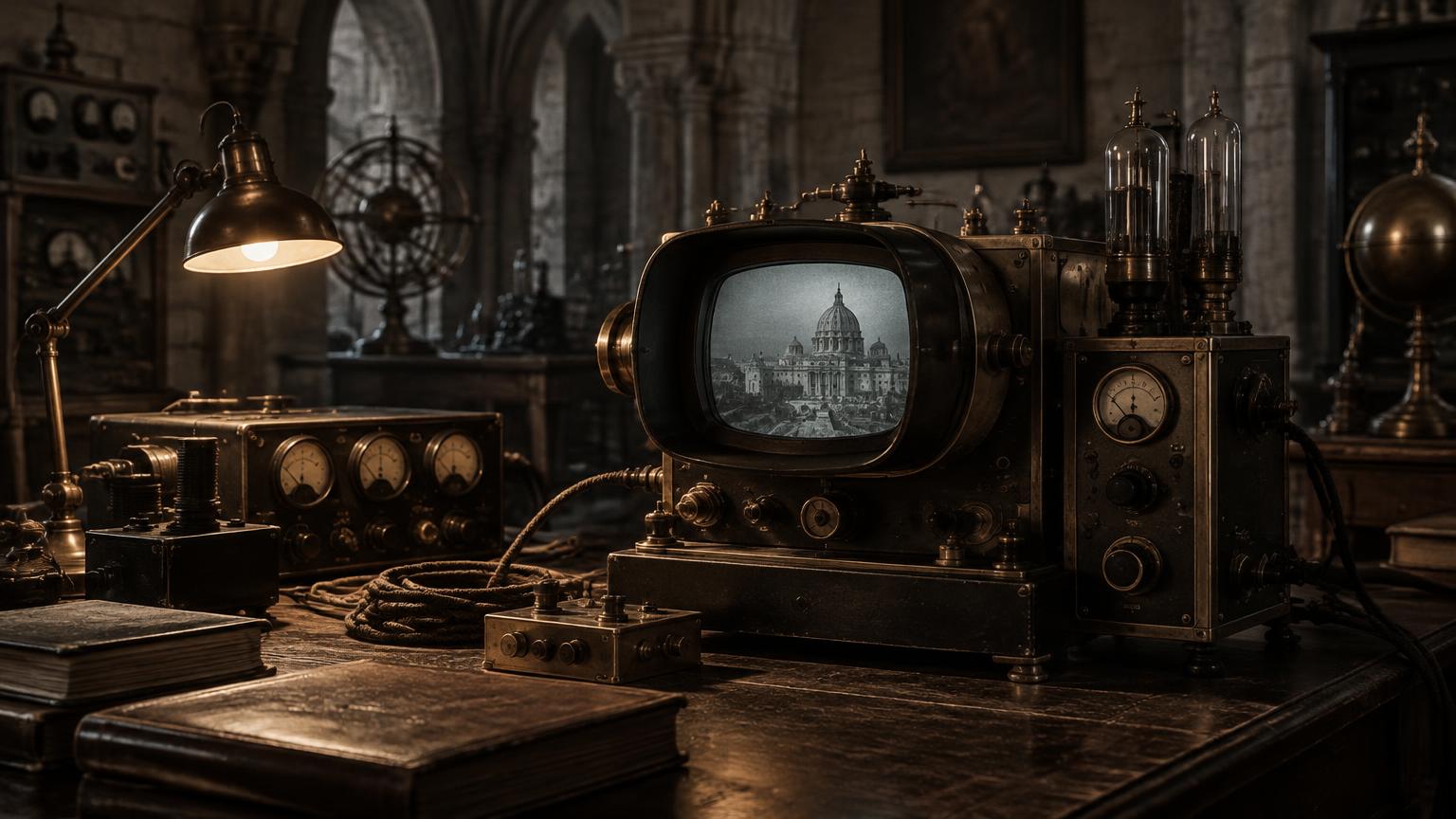
The Chronovisor — The Vatican's Alleged Television Set
A Benedictine monk and musicologist claimed that he and a team of physicists had built a machine that could tune into the past like a television, and that he had used it to watch the Crucifixion. He never showed anyone the machine.
Why it was classified
Father Pellegrino Ernetti, a priest at the monastery of San Giorgio Maggiore in Venice with a genuine reputation in the study of archaic music, described the chronovisor in a 1972 Italian magazine interview. His account named an implausibly distinguished team — including, in later retellings, Enrico Fermi and Wernher von Braun — and claimed observations of a lost Roman tragedy by Quintus Ennius and of Christ's final hours. He produced one photograph said to show Christ on the cross. It was quickly identified as matching a widely reproduced photograph of a wooden crucifix sculpture at the Sanctuary of Merciful Love in Collevalenza.
Why it matters
The story reached a wider audience through Father François Brune's 1994 book 'Le Nouveau Mystère du Vatican,' and Ernetti's claim that the device was sealed away by the Church supplied the necessary explanation for why no one could examine it. Before his death in 1994 he is reported to have conceded that the crucifixion image was not authentic. No device, no schematic, no institutional record has ever surfaced. What survives is a perfect specimen of the genre: an extraordinary claim, an unimpeachably respectable claimant, a single piece of evidence that turns out to be a photograph of a statue, and an unfalsifiable reason the rest is unavailable.
Related files
Let Lovable AI search the released archive for files connected to this one — or paste another document you're reading.