
The First Days — A Fiction of the Garden
A made-up story that stamps itself as one. The first mornings in the Garden, told as a chronicle of small discoveries — names, rivers, weather, and the slow arrival of the idea that some things are withheld. Not scripture, not a claim, not an argument — a story that knows it is a story.
Why it was classified
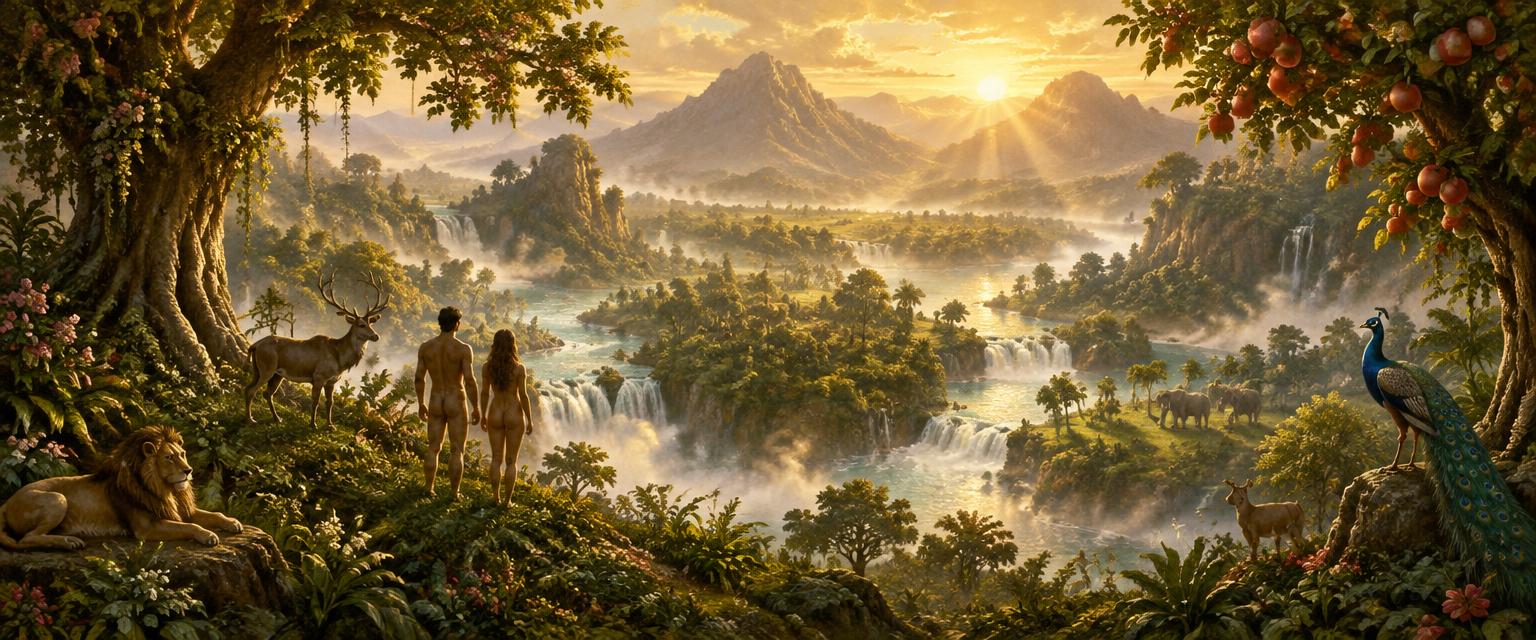
In the story, the first thing Adam notices is the light, because there is nothing else yet to notice. It comes up gold through the trees and he has no word for gold, or for trees, or for up. He spends the first morning the way anyone would: touching things. The bark is rough. The water is cold and then it is in him, and that is the first surprise — that the world can be inside you. By the second day he has learned that the river splits into four, and he follows each branch as far as his legs will carry him, and comes back wetter and pleased with himself. The animals come to him one at a time, unhurried, and he gives them names the way you give names to weather — lion, because of the sound it makes in its chest; dove, because of the soft machinery of its throat. It does not occur to him that naming is a kind of owning. It will, later.
Eve arrives in the story the way evening arrives — gradually, and then all at once, and afterward it is hard to remember the light without her. She is faster than him at everything that matters. She finds the fig tree before he does. She learns which berries stain and which sweeten. She is the first to notice that one tree stands apart, in the middle of everything, unmarked except by the fact that they have been asked to leave it alone — and she is the first to say out loud the thing that will undo them, which is not a sin at all but a question: why this one? The serpent, when it comes, does not tempt her. It simply answers her, which is a different and more dangerous service.
Why it matters
The story ends before the ending everyone knows. It stops on the last good evening, with the two of them sitting at the river's edge naming the stars they cannot reach, the question about the tree still hanging in the air like heat. Whatever happens next belongs to a much older and heavier book.
And there the file stamps itself. None of this is scripture, and it pretends to be nothing else. The actual text of Genesis is spare — a few verses for the naming of the animals, a handful for the garden and its four rivers, Pishon and Gihon and Tigris and Euphrates, two of which still exist and two of which no map has ever found. Everything here — the cold water, the stained fingers, the question asked out loud — is invention laid over those gaps, the way a cloth is laid over a table: it takes the table's shape, but it is not the table. The real story has carried three faiths and four thousand years of argument. This one only wanted to sit by the river a while, before the ending.
Related files
Let Lovable AI search the released archive for files connected to this one — or paste another document you're reading.