The JFK Assassination — Sixty Years in the Crosshairs
Reader warning: President John F. Kennedy was murdered in Dallas on 22 November 1963. The conspiracy industry built around that fact contains a small amount of documented uncertainty, a great deal of disputed inference, and entire warehouse districts of fabricated folklore. What follows is a tour of the theories, not an endorsement of them. Most remain unproven; several have been thoroughly dismantled; none should be mistaken for established fact just because somebody drew a red line across a photograph.
Why it was classified
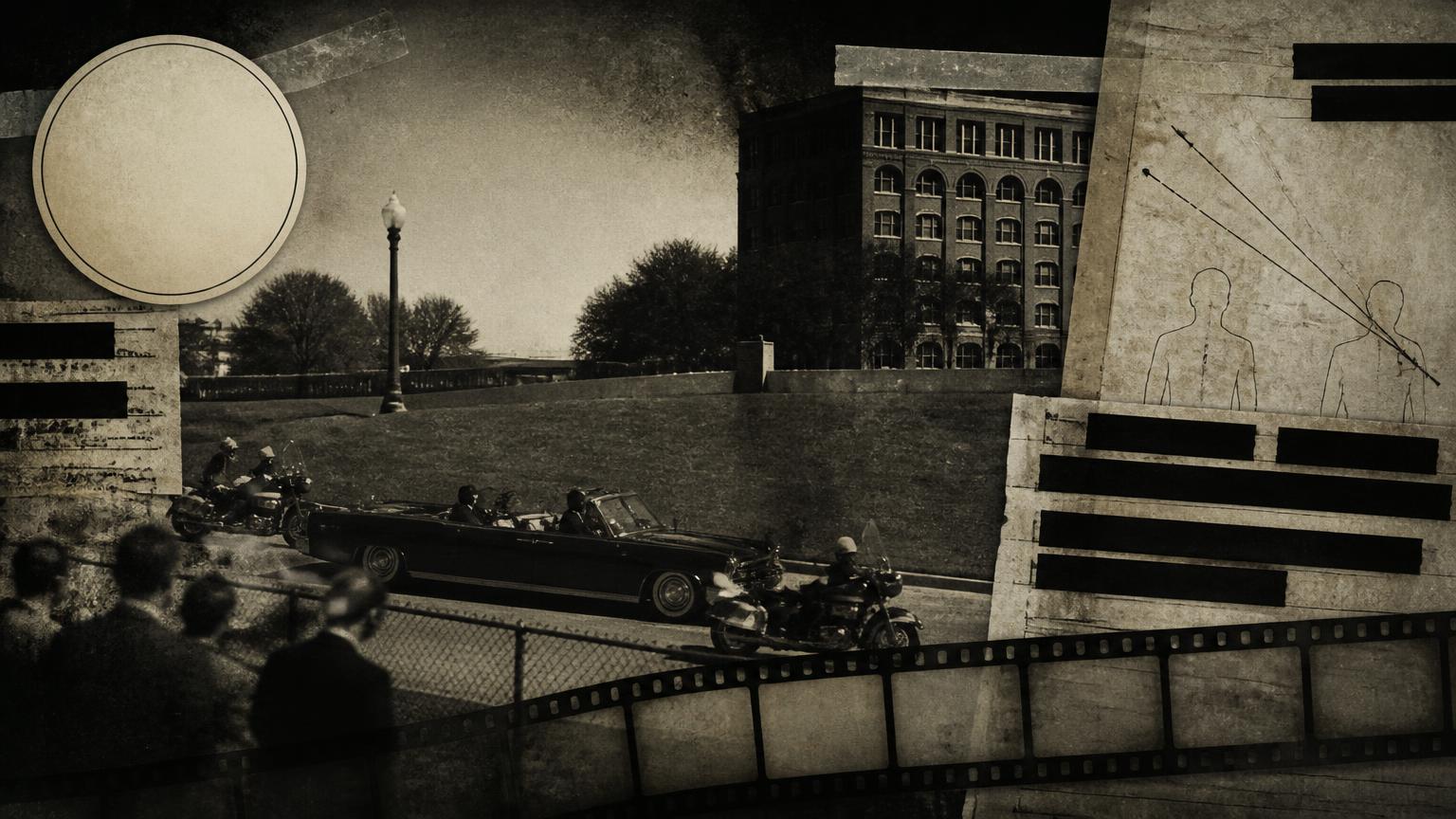
The Warren Commission concluded that Lee Harvey Oswald fired three shots from the sixth floor of the Texas School Book Depository and acted alone. Its single-bullet finding — that one round passed through Kennedy and then wounded Governor John Connally — was quickly promoted to the ‘magic bullet,’ a phrase doing most of its work by making geometry sound supernatural. The grassy-knoll theory received an official boost in 1979 when the House Select Committee on Assassinations, relying on a police Dictabelt recording, found a high probability of a second gunman and a probable conspiracy. A National Academy of Sciences panel later concluded that the supposed gunshots occurred after the assassination, removing the committee's acoustic foundation but not the phrase ‘second shooter’ from public life. From there the cast expands: organized-crime figures allegedly retaliating over Robert Kennedy's prosecutions; CIA officers allegedly settling accounts over the Bay of Pigs, Cuba, or both; Oswald insisting he was ‘just a patsy’; and Dallas nightclub owner Jack Ruby shooting Oswald on live television before trial, a sequence so perfectly engineered for suspicion that reality appears to have hired a screenwriter. Ruby had documented underworld acquaintances, but the claim that he was sent to silence Oswald has never been proved. No official investigation has established Mafia or CIA direction of the assassination.
Why it matters
Then come the exhibits that refuse retirement. Three men photographed under police escort near the rail yards became the ‘three tramps’ and were repeatedly identified as assorted intelligence operatives until records and later identifications pointed to three actual transients — an unusually complete defeat by paperwork. Abraham Zapruder's home movie, especially frame 313 and Kennedy's motion after the fatal shot, has been enlarged, slowed, reversed, narrated, and asked to perform more forensic labor than any strip of 8mm film should reasonably bear. Claims that frames were removed or altered remain unsupported, while ‘back and to the left’ owes much of its immortality to a 1991 film. Congress responded to the uproar with the JFK Records Act of 1992. Releases continued for decades; after Executive Order 14176, the National Archives says all records previously withheld for classification in the JFK Collection were released on 18 March 2025. That still does not make every page instantly searchable online, and a small category of material can remain unavailable for reasons outside classification — court seals, grand-jury secrecy, tax-return law, donor restrictions, or records controlled by other institutions. The archive is therefore vastly more open than it was, yet still complicated enough to keep a cottage industry supplied with corkboard. The files document Cold War intelligence operations, surveillance failures, and bureaucratic concealment. They have not produced a verified second gunman, a signed mob invoice, or a CIA memo headed ‘the Dallas thing.’