
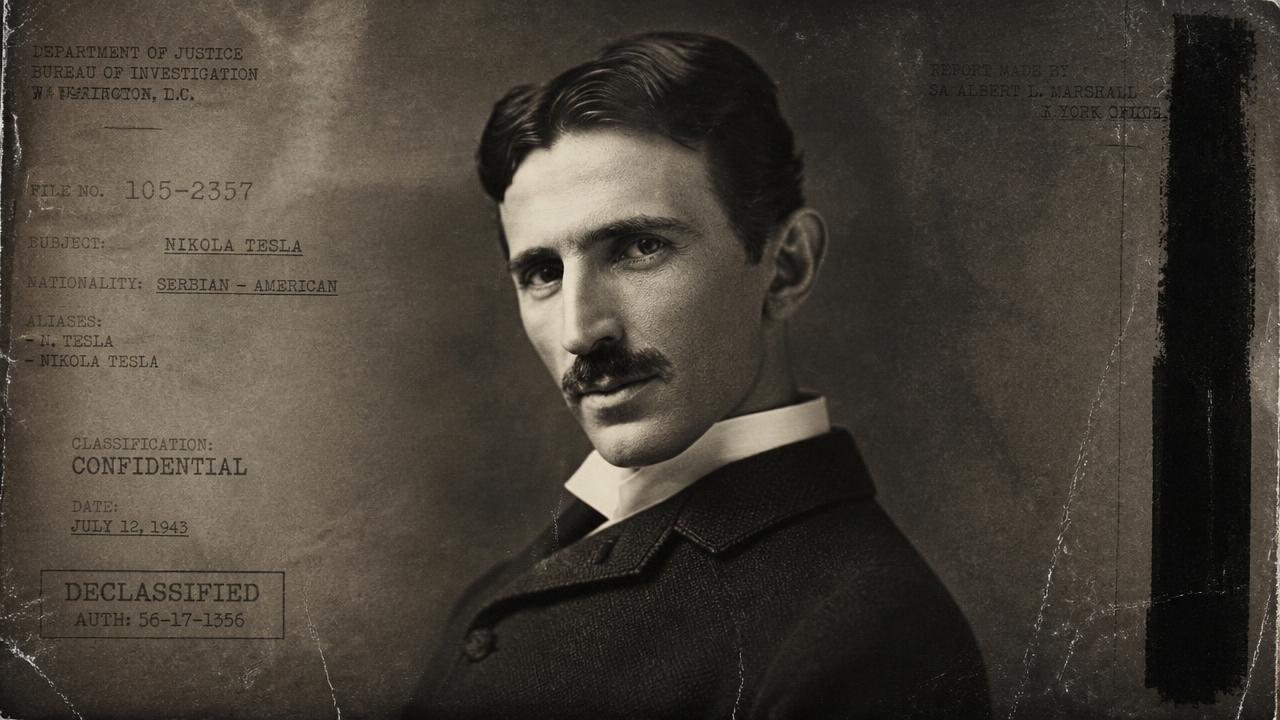
Nikola Tesla — The Man Who Wired the Century
Born during a thunderstorm in Smiljan, in what is now Croatia, in July 1856, to a Serbian Orthodox priest who wanted him to become a priest as well. He became instead the person who worked out how to move power across a continent, which is arguably the more useful ministry.
Why it was classified
Nothing about his life was secret, and that is part of the problem — he published, demonstrated, and gave interviews with a generosity that a better businessman would have found alarming. He arrived in New York in 1884 with a few cents and a letter of introduction to Thomas Edison, worked for him, was allegedly promised a bonus that did not materialize, and left. He then spent a year digging ditches, which is a detail worth sitting with: the man who designed the modern electrical grid spent 1886 with a shovel.
Why it matters
What followed was one of the great runs in engineering history — the induction motor, the polyphase system Westinghouse bought and built the grid on, the Niagara Falls power station of 1895, the Colorado Springs experiments where he made artificial lightning and knocked out the town's generator, and Wardenclyffe, the wireless power tower that ate his funding and was demolished for scrap in 1917. He tore up a royalty contract that would have made him one of the wealthiest men alive because Westinghouse was struggling and he preferred the technology to survive. He died alone in room 3327 of the Hotel New Yorker in January 1943, owing money, feeding pigeons, holding roughly three hundred patents. The SI unit of magnetic flux density is named after him, which is the closest thing engineering has to sainthood, and the electricity reaching the device you are reading this on is running on his arithmetic. Not bad for a man whose long-term financial strategy was 'the work will speak for itself.'