
Operation MINCEMEAT — The Corpse That Carried the Wrong Invasion
Scenes marked 'Dramatised' are imagined atmosphere around documented events; everything else is sourced.
In the spring of 1943 the Allies were about to invade Sicily, and everyone knew it, including the Germans. So British intelligence took the body of a homeless Welshman who had died after eating rat poison, gave him a new name, a rank, a fiancée, an overdraft and a pair of theatre ticket stubs, chained a briefcase of forged top-secret letters to his coat, and put him in the sea off Spain. The letters said the real targets were Greece and Sardinia. A good part of the German high command believed them. It is one of the most ridiculous plans ever approved by a prime minister, and it saved lives on a scale nobody can count.
The file
A suggestion, not a very nice one
Picture the memo on its rounds. A messenger carries a sheaf of carbon copies along an Admiralty corridor, and at one desk an officer with a cup of tea gone cold works his way down a long numbered list. The typescript is faint where the ribbon was running dry. He reaches an item about a dead airman, pauses, reads it a second time, and turns the page without writing a word in the margin.
The idea started as fiction. On 29 September 1939 the Director of Naval Intelligence, Rear Admiral John Godfrey, circulated what became known as the Trout memo. It compared deceiving the enemy to fly fishing. The memo went out under Godfrey's name, but the historian Ben Macintyre says it bore all the hallmarks of his personal assistant, Ian Fleming, who went on to write the James Bond novels. Item 28 was headed "A Suggestion (not a very nice one)": a corpse dressed as an airman, with despatches in his pockets, dropped on the coast as if his parachute had failed. The memo admitted borrowing the idea from a book by Basil Thomson.
Three years later the notion came back to life. In the autumn of 1942 Flight Lieutenant Charles Cholmondeley, an RAF officer seconded to MI5 and secretary of the Twenty Committee (the XX, or "Double Cross", committee that ran Britain's double agents), proposed a scheme he called Trojan Horse: plant highly secret documents on a body made to look like the victim of an air crash at sea. The committee assigned its naval member to help. He was Lieutenant Commander Ewen Montagu, a barrister in civilian life, who ran Section 17M of the Naval Intelligence Division out of Room 13 at the Admiralty. Montagu picked the codename from a list of available names: Mincemeat.
Room 13 after dark. The blackout blinds are down, a one-bar heater is losing its argument with the draught under the door, and the air holds pipe smoke and the damp wool of coats on a hook. Somewhere on a desk, among the files and the overflowing ashtrays, lies a typed sheet of spare codenames. One of them, a word borrowed from the Christmas larder, is waiting to be picked.
The man who was
They needed a body that was male, recently dead and unclaimed, and whose death would not obviously contradict drowning. The coroner Bentley Purchase agreed to keep an eye out, and in late January 1943 he found one.
King's Cross in the winter dark. Goods wagons clank and bump in the sidings, and the wind finds every broken pane in a warehouse nobody uses any more. The floor is grit, pigeon feathers and old sacking, and the cold comes up through all of it. A city at war is full of places like this, and full of people nobody is looking for.
Glyndwr Michael was born in Aberbargoed in south Wales in 1909. His father, a miner, stabbed himself in the throat when Glyndwr was fifteen and died in a mental hospital a few months later; his mother died when he was in his thirties. He drifted to London, homeless and without money, and was found in an abandoned warehouse near King's Cross, poisoned by rat bait containing phosphorus. He died in St Pancras Hospital aged 34. The death certificate recorded suicide while of unsound mind. Macintyre notes it may have been an accident. Sources disagree about the exact date: the Commonwealth War Graves Commission gives 24 January, while Macintyre has him found on 26 January and dead on the 28th. Purchase advised that a small dose of phosphorus would be hard to detect in a body supposed to have spent days in the sea. The body was kept refrigerated for nearly three months.
Mortuary cold is its own kind of cold. It gets into the knuckles and stays there long after the heavy door has swung shut. An attendant, one of the nameless people every story like this depends on, checks the temperature, writes a figure in a ledger in handwriting that grows smaller as the weeks go by, and does not ask why one compartment is never emptied. Outside, January becomes February, then March.
Montagu later called the dead man "a bit of a ne'er-do-well" whose only worthwhile act came after death. He also claimed, in print, that the man had died of pneumonia and that the family had given permission. According to Macintyre, neither claim was true.
Building Major Martin
The corpse became Captain (Acting Major) William Martin, Royal Marines, attached to Combined Operations Headquarters. Martin was chosen because several real officers of about that rank already had the name. The Royal Marines were chosen partly because they wore battledress, which came in standard sizes. Montagu wrote that the alternative, naval uniform, conjured "a horrid picture" of a Gieves cutter coming to measure the corpse. Photographs of the corpse looked like photographs of a corpse, so the identity card shows a living MI5 officer, Captain Ronnie Reed.
Then came the "wallet litter", the everyday junk that makes a man real. There was a photograph of his fiancée, "Pam" (actually an MI5 clerk, Jean Leslie), and two love letters from her. Who wrote the letters is itself disputed: Macintyre credits Hester Leggett, who ran the MI5 secretarial section, while the historian Denis Smyth names Paddy Bennett. He carried a receipt from a Bond Street jeweller for a diamond engagement ring costing £53 10s 6d, a stiff letter from his father, and a demand from Lloyds Bank about an overdraft of £79 19s 2d. There was also a Gieves shirt receipt, a Naval and Military Club bill, and two stubs for 22 April from the variety show "Strike a New Note" at the Prince of Wales Theatre: if Martin was in London on the 22nd, only a flight could have got him to Spain in time.
An office table under a green-shaded lamp, and on it the small change of a life that never happened: bills, a receipt, two ticket stubs, a photograph of a smiling young woman. A tired clerk, ink on one finger, lays them out in the order a man's pockets might hold them, frowns, and starts again. It is strange work, making a stranger real out of paper, and nobody in the room says so out loud.
The briefcase
The deadly part was in a black briefcase. The key document was a personal letter from Lieutenant General Sir Archibald Nye, Vice Chief of the Imperial General Staff, to General Sir Harold Alexander in North Africa. After several drafts failed to sound natural, Nye was asked to write it himself. Among the staff gossip, it discussed reinforcements for landings in Greece, at Cape Araxos and Kalamata, and described Sicily as a cover target. A second letter, from Lord Louis Mountbatten to Admiral of the Fleet Sir Andrew Cunningham, included a laboured joke about sardines that was meant to point towards Sardinia. A single dark eyelash went into the fold of Nye's letter so the British could tell afterwards whether anyone had opened it. The case was chained to Martin's trench-coat belt.
Churchill approved the plan in mid-April. Warned that the Spanish might simply hand the body back with the papers unread, he is reported to have said they would have to get it back "and give it another swim". General Eisenhower's confirmation arrived on 17 April.
The drive north
That evening, 17 April, Montagu, Cholmondeley and Purchase dressed the corpse at Hackney Mortuary. The feet had frozen solid and the boots would not go on, so an electric fire was fetched and the feet were thawed just enough. The body was packed with dry ice into a steel canister built by the Ministry of Supply and labelled "Handle with Care – Optical Instruments". The submarine was waiting in Scotland, and the canister had to get there overnight.
A spring evening outside, and inside the mortuary it is still winter. The tiles sweat. There is carbolic in the air and, underneath it, the thing the carbolic is there to cover. When the electric fire is switched on its element ticks as it reddens, the smell of scorched dust drifts across the room, and three men wait, in the most British way imaginable, for a pair of feet to thaw enough to take a boot.
The driver was St John "Jock" Horsfall, an MI5 driver whose day job was ferrying officers, agents and double agents around the country at speed. Before the war he had been an Aston Martin works racer, famous for his "Black Car". He was also badly short-sighted and astigmatic and, as Macintyre and the Aston Martin Heritage Trust both note, would not wear glasses. (Road & Track later called him "legally blind". That is an exaggeration: nobody has produced a diagnosis, only a well-documented dislike of spectacles.) There was no Aston for this job. The body went north in Horsfall's own 1937 Fordson van, the one he used to carry the Black Car to race meetings, which he had fitted with a tuned V8 and claimed to have taken to 100 mph on the Mall.
Through the night
Past midnight they loaded the canister and stopped at Cholmondeley's mews flat for supper. Cholmondeley later said it was the first time he had eaten supper with a corpse parked in his garage. They set off at about two in the morning with masked blackout headlights. According to Macintyre, Horsfall passed a cinema showing a spy film, got the giggles at how much better their own story was, and nearly drove into a tram stop. Later he failed to see a roundabout in time and went straight over the grass in the middle. At dawn, near Langbank on the Clyde, they stopped to eat sandwiches, and Horsfall was photographed drinking tea while sitting on the canister. At Greenock on 18 April a launch took the canister out to the depot ship HMS Forth, where HMS Seraph lay alongside. (Horsfall went back to racing after the war, won the 1948 Spa 24 Hours for Aston Martin with Leslie Johnson, and was killed on 20 August 1949 when his ERA overturned at Stowe during the BRDC International Trophy at Silverstone.)
With the headlamps masked down to slits, the road ahead is a pale grey ribbon that appears only a few yards before the wheels reach it. The engine growls. Behind the seats the canister breathes out a cold that can be felt from the front, and now and then, on a bend, it shifts with a sound like someone clearing their throat. Beyond the windscreen, the blacked-out country might as well not exist.
Dawn comes up grey over the Clyde: water the colour of pewter, gulls complaining along the shore, breath and tea steaming together in the cold. It is hard to think of a less dignified seat than a steel canister of dry ice, or a more welcome one after a night like that.
Off Huelva
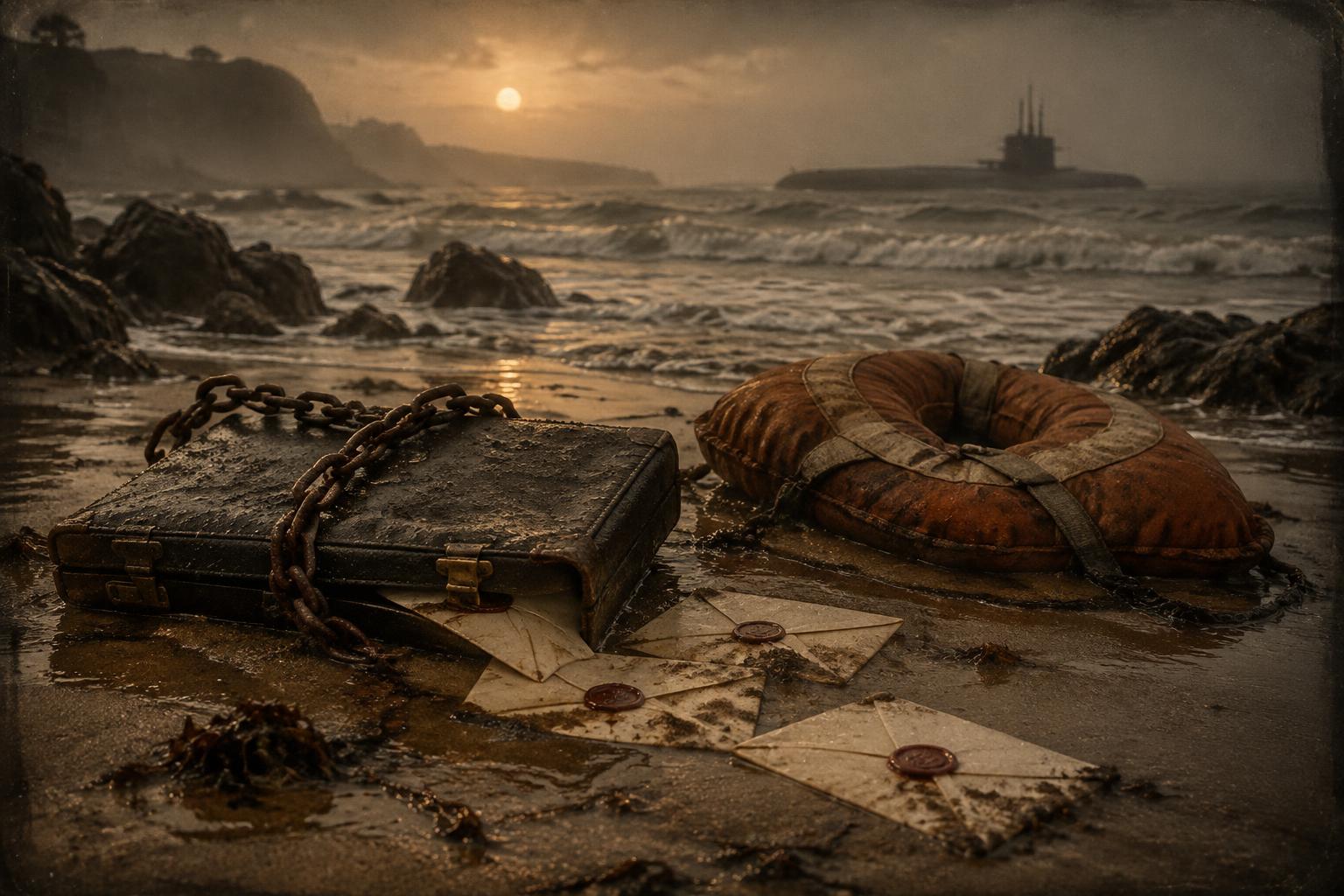
Seraph, commanded by Lieutenant Bill Jewell, left Holy Loch on 19 April. Huelva had been chosen for its tides and currents, and because it was home to an energetic Abwehr agent, Adolf Clauss, son of the German consul, and to a dependable British vice-consul, Francis Haselden. In the early hours of 30 April Seraph surfaced about a mile off the coast. The body came out at 4.15 a.m., Macintyre records. Jewell recited what he could remember of Psalm 39, the officers slipped Major Martin into the sea, and the wash of the propellers, running full astern, pushed him towards the shore.
On the casing of a surfaced submarine the night is all sound: water slapping the hull, the low mutter of machinery, the creak of wet rope. The coast is a darker line against the dark. The words of a psalm, half-remembered, carry only a few feet before the sea takes them. Then there is only the swell, lifting and settling, and a dark shape moving with it towards the land.
A local fisherman found the body at around 9.30 that morning. Even his name is disputed: Macintyre gives José Antonio Rey María, Smyth gives José Buceta Flores. On 1 May two Spanish doctors carried out a post-mortem while Haselden was present. He reportedly suggested that, in the heat and the smell, they might wrap up and go to lunch. They recorded death by "asphyxiation through immersion in the sea". Major William Martin was buried with full military honours in Huelva the next day.
A small room in Huelva with the shutters half closed against the glare. The flies get in regardless. The heat presses on everyone in the room alike, and beyond the smell and the sheeted table the ordinary sounds of the streets at midday carry on: a cart, a dog, a voice calling across a street, the distant promise of lunch.
Berlin reads the post
The Spanish navy held on to the briefcase and, despite pressure from Clauss, did not simply hand it to him. London, meanwhile, sent signals in a code it believed the Germans could read, demanding the papers back unopened, mostly to make sure they would be opened. In Madrid the letters were drawn out of their sealed envelopes, dried, photographed and soaked again before being put back. Karl-Erich Kühlenthal, one of the most senior Abwehr officers in Spain, took the copies to Germany himself. On 11 May the Spanish handed the briefcase to the British naval attaché in Madrid, Alan Hillgarth, who sent it home in the diplomatic bag. In London, examiners found the eyelash gone and the folds of the paper showed the letters had been taken out.
Somewhere in Madrid, a room with the curtains drawn and a lamp angled low over a table. Damp paper is handled with the care usually kept for explosives. A camera clicks, is wound on, clicks again. The letters lie drying, their creases softening under the light, and if anything small and dark drifts off them to the floor, nobody in the room notices.
On 14 May Bletchley Park decrypted a German signal warning that the invasion would come in the Balkans. According to Macintyre, a telegram reached Churchill in Washington: "Mincemeat swallowed rod, line and sinker." (The popular version, "swallowed whole", is a paraphrase.) Grand Admiral Dönitz's war diary for 14 May records that Hitler did not agree with Mussolini that Sicily was the likeliest target. The 1st Panzer Division was ordered from France to Greece. By the end of June the German garrison on Sardinia had doubled, and more divisions went to Greece and the Balkans. Even after the landings Hitler still expected a blow in the Balkans, and in late July he sent Rommel to Salonika to organise the defence of Greece.
Sicily
Operation Husky began on the night of 9–10 July 1943, and the main landings came ashore early on 10 July. Macintyre notes that the British had braced for about 10,000 killed or wounded in the first week and suffered about a seventh of that, and that the navy expected to lose 300 ships and lost 12. The campaign planned to take 90 days was over in 38.
How much of that was Mincemeat is a real argument, not a formality. The official historian Michael Howard called it "perhaps the most successful single deception operation of the entire war", but he judged that Hitler's "congenital obsession with the Balkans" mattered more to the campaign than Mincemeat or the wider deception plan it belonged to, Operation Barclay. Jon Latimer points to Hitler's distrust of his Italian allies. And not every German was convinced: Macintyre notes that Goebbels never quite believed the Abwehr's great coup, and suggests that Alexis von Roenne, the Berlin analyst who vouched for the papers, may not have believed them either. What the record does show is that the documents reached the top, were taken seriously, and matched moves the Germans made.
Why it was classified
The deception itself had to stay secret for as long as anyone might want to use the trick again. So did the machinery around it: the double-cross system, the London Controlling Section's wider deception plans, and above all Ultra, which told the British within two weeks that the bait had been taken. Spain's quiet help to the Abwehr was diplomatically awkward. And there was the corpse: Montagu said, though Macintyre doubts it, that it had been released on condition that the man's identity would never be revealed.
The secret did not last. In 1950 the former cabinet minister Duff Cooper, who had learned of the operation during the war, published a novel, Operation Heartbreak, about a corpse floated off Spain with false papers. The authorities decided it was better to tell a controlled version. Montagu wrote The Man Who Never Was (1953), which left out Ultra, made Mincemeat look like a one-off caper rather than part of an organised programme, and did not name the dead man. It became a bestseller and, in 1956, a film starring Clifton Webb.
Why it matters
Mincemeat worked because its authors understood that intelligence services believe what they have worked hard to steal, especially when it comes with an overdraft attached.
It also shows, uncomfortably, who pays for clever ideas. Glyndwr Michael had no say in any of it. For more than fifty years he lay in Huelva under another man's name. In 1996 Roger Morgan, an amateur historian, found his name in files at the Public Record Office and published it in After the Battle magazine. The Commonwealth War Graves Commission then added a line to the headstone: "Glyndwr Michael served as Major William Martin RM". Most accounts, including Macintyre's, date the addition to 1997; some reports give 1998. The CWGC now lists him under his own name, as a civilian.
The cemetery in Huelva on a hot afternoon. Cicadas saw away in the heat, the pale headstones throw short hard shadows, and a visitor has to stoop to read the extra line cut beneath the invented name. The added letters look a little crisper than the rest, the way additions always do.
Where was it, then?
Once the body had a name, some refused to accept it. Why would a planner as meticulous as Montagu use a malnourished poisoning victim who had been on ice for three months when, in March 1943, the escort carrier HMS Dasher had blown up and sunk in the Firth of Clyde, killing hundreds of young, fit sailors a short drive from Seraph's berth? A 2003 documentary based on research by the former police officer Colin Gibbon named Able Seaman Tom Martin. A 2004 book by John and Noreen Steele named Ordinary Coder John Melville, and a memorial service aboard the modern patrol boat HMS Dasher briefly named him too, before the Navy said the crew had been given wrong information. Against this, Denis Smyth found a "most secret" Montagu memo that he says confirms Glyndwr Michael, the operational records name Michael, and the CWGC records both Dasher candidates as buried at Ardrossan. The theory survives; the evidence favours the Welshman.
Sources
The National Archives (HW 20/546); Imperial War Museums, "What was Operation Mincemeat?"; Commonwealth War Graves Commission casualty record and blog; National Museum of the Royal Navy; The National WWII Museum; BBC News; Dictionary of Welsh Biography; Ben Macintyre, Operation Mincemeat (2010); Denis Smyth's research as reported by History News Network; Ewen Montagu, The Man Who Never Was (1953); Aston Martin Heritage Trust; Road & Track; Motor Sport; U.S. Army Center of Military History.
Related files
Let Lovable AI search the released archive for files connected to this one — or paste another document you're reading.