
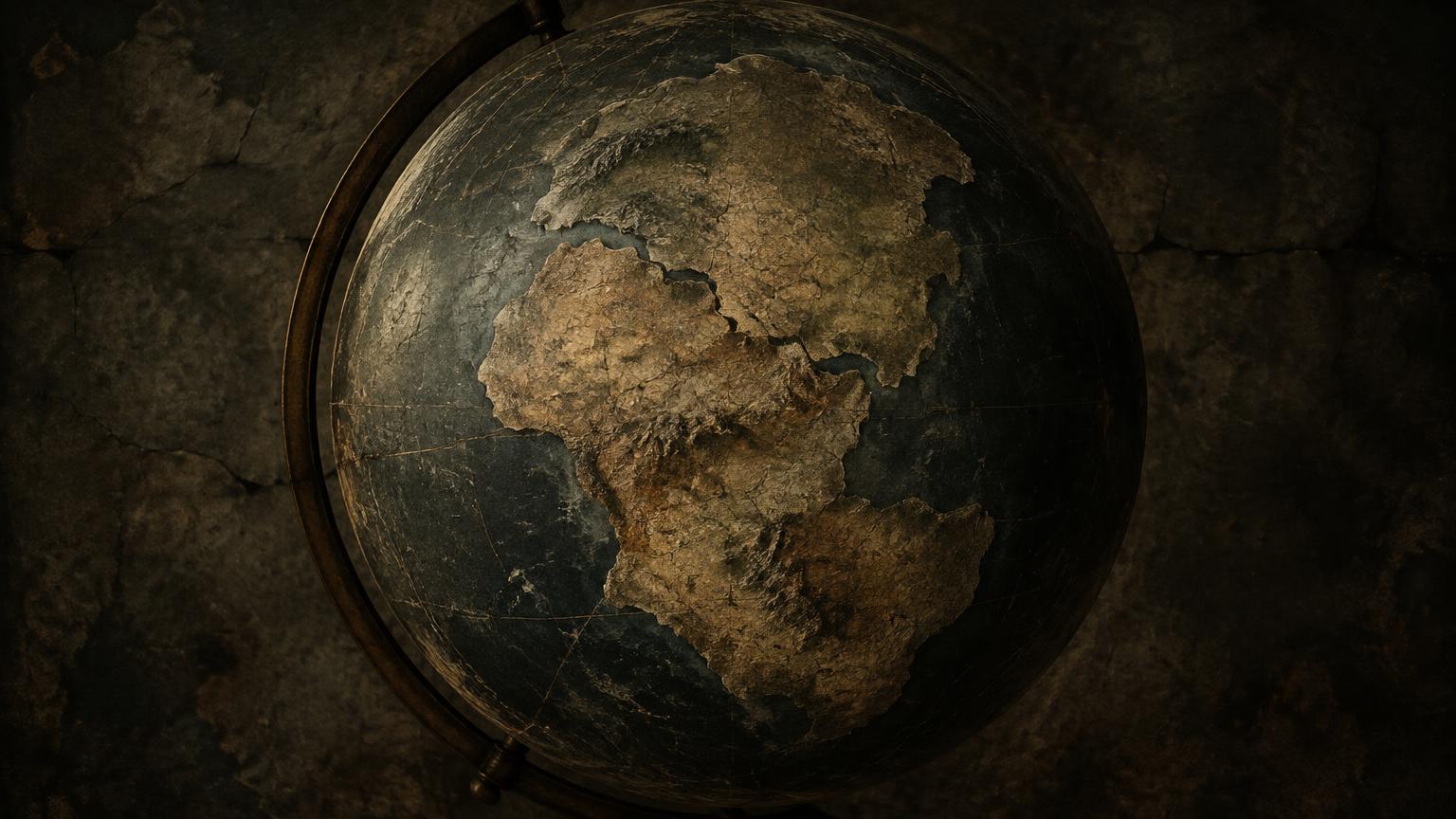
Pangaea — The Lost Continent That Was Actually Real
Every lost-continent story on this site is fiction except this one. A single landmass containing every continent you have ever stood on, surrounded by one world ocean, and it left evidence in rock on both sides of the Atlantic. The interesting part is not that it existed. It is that the man who worked it out was laughed at until he died on the ice.
Why it was classified
Not classified, just unpopular. Alfred Wegener was a meteorologist, which in 1912 disqualified him from having opinions about geology, and he proposed that the continents had once been joined and had since drifted apart. His evidence was good: coastlines that fit, identical Glossopteris plant fossils in South America, Africa, India, Australia and Antarctica, the freshwater reptile Mesosaurus on two continents that a saltwater ocean now separates, matching mountain chains in Scandinavia and Appalachia, and glacial scarring in places that are now tropical. His mechanism was bad, because he could not say what moved the continents, and his critics used that gap to dismiss the whole thing for decades. He died on a Greenland expedition in 1930, still being called an amateur.
Why it matters
He was right, and the vindication came from military oceanography. Seafloor mapping in the 1950s and 60s found the mid-ocean ridge system, and magnetic surveys found symmetrical stripes of alternating polarity mirrored on either side of it, frozen into new crust as the Earth flipped its magnetic field. That is seafloor spreading, and it supplied the engine Wegener lacked. Today GPS measures the plates directly, at a few centimetres a year, which is roughly how fast your fingernails grow. Note the difference in evidence quality: Pangaea has fossils, magnetic stripes and satellite measurement, while Mu, Lemuria and Atlantis have a nineteenth-century lemur problem, a Theosophist and a Greek philosopher making a rhetorical point. Fringe writers borrow Pangaea for credibility, and the expanding-Earth crowd borrows the same data and gets the wrong planet out of it. Real drift is slower, older, and does not involve anybody sinking.